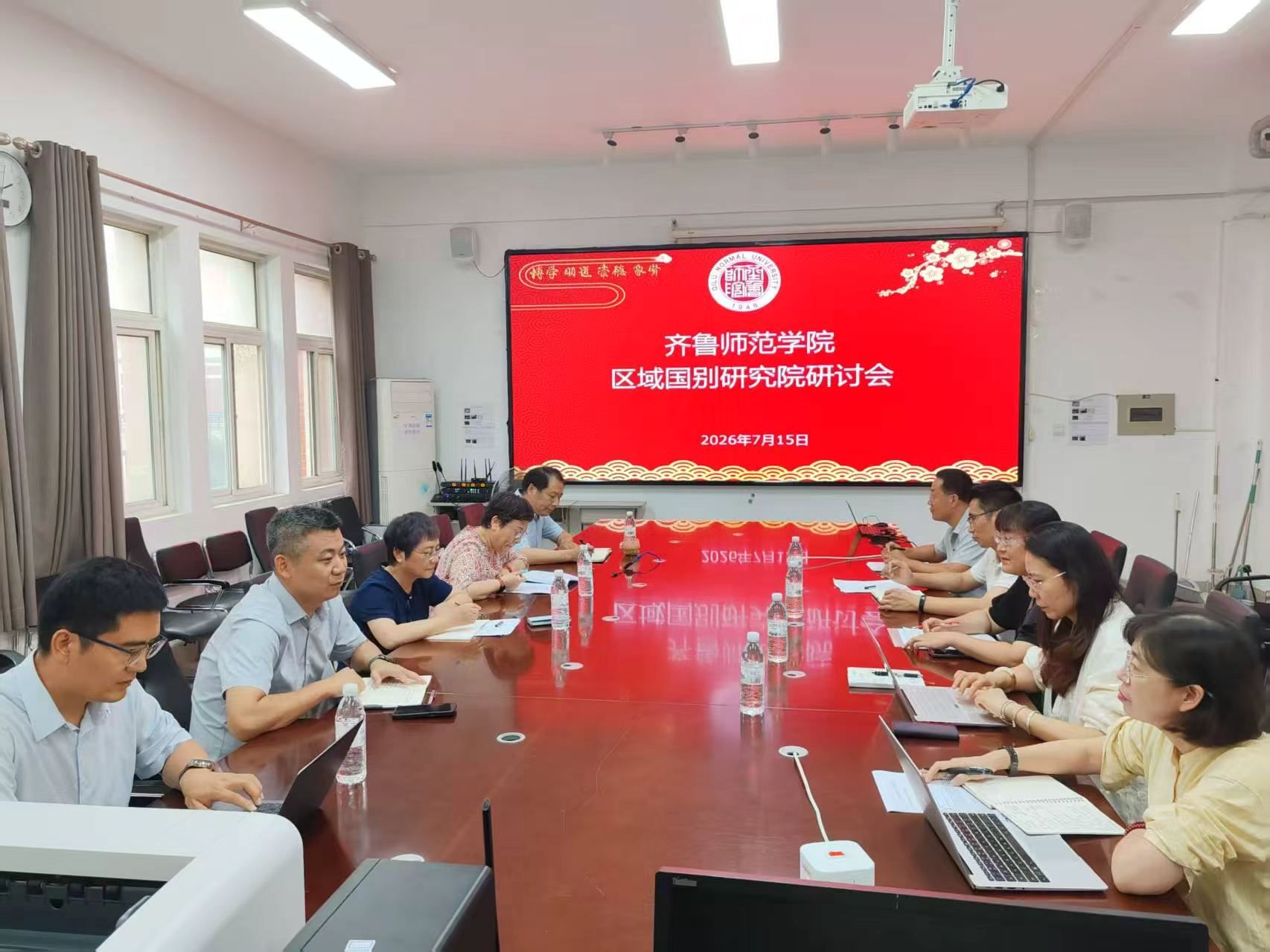
In order to deeply integrate national-level cooperation with Africa and the strategic deployment of the China-Portuguese-Speaking Countries Economic and Trade Cooperation Forum, to implement the school’s regional and country-specific research development positioning of “focusing on Qilu, serving Shandong, and looking towards the global,” and to improve the research layout for the Portuguese-speaking island nations in the Atlantic, the Regional and Country-Specific Research Institute recently organized a special symposium on country-specific research for Cape Verde and São Tomé and Príncipe. Zhu Ruibin, Deputy Director of the Scientific Research Department; Song Xiukai, Executive Dean of the Institute; Zhou Jian, Ge Yuemei, and other key faculty members and young researchers from the East African Research Center, the School of Marxism, the School of Literature and History, the School of Economics and Management, the School of Teacher Education, and the School of Foreign Languages participated in the symposium, engaging in systematic discussions and exchanges on the contemporary value, practical necessity, research directions, and implementation paths of the studies on the two major Portuguese-speaking island nations in West Africa.
At the symposium, Song Xiukai first explained the core background and great significance of this special symposium.She pointed out that Cape Verde, São Tomé and Príncipe are located on the strategic route of the Gulf of Guinea in the Atlantic Ocean.It is a key country in China's cooperation in the Portuguese-speaking circle in West Africa and the South Atlantic Islands, and at the same time, relying on the Macao China-Portugal platform, it is an important cooperation object for Shandong to expand its blue economy, cultural tourism, economic and trade, and agricultural technology exports to Africa. At present, the domestic academic circles in China are systematically studying the small Portuguese-speaking islands in West Africa. The research on normalization is relatively weak, the research results of relevant think tanks in the province are scarce, there are research gaps, insufficient data reserves, and a shortage of application-oriented research results, and it is of great strategic necessity, local service necessity, and discipline construction necessity to carry out special research.
The participants deeply discussed the practical value of the research on the two island countries from different dimensions:
First, it is in line with the strategic needs of China's diplomacy and the construction of a community with a shared future for China and Africa. Cape Verde has been deeply engaged in marine hubs, digital economy, and island ecological governance for a long time, and has continued to deepen cooperation with China in the fields of blue partnership, climate governance, remote sensing scientific research, and new energy infrastructure. Since the resumption of diplomatic relations in 2016, the bilateral relations between Sao Tome and Principe have been upgraded to a strategic partnership. China's assistance and cooperation in the fields of ports, agriculture, medical care, and housing have yielded fruitful results. Both countries firmly adhere to the one-China principle and coordinate their voices on the multilateral international stage. In-depth research on countries can accurately sort out the context of bilateral cooperation, judge the regional geopolitical situation, and provide academic support for China to deepen friendly exchanges with Portuguese-speaking island countries in West Africa.
The second is to serve the local needs of Shandong Province's high-level opening-up and economic and trade overseas. Shandong is a large province for economic and trade, agricultural technology export to Africa, and has advantages in new energy, seawater desalination, deep-sea fishing, and distinctive cultural tourism industry.Cape Verde strives to build a digital hub in the Atlantic region, and São Tomé and Príncipe has the potential for cocoa, fisheries, and marine tourism development. The industrial needs of the two places are highly compatible with the advantageous industries of Shandong.Building a system of country-specific research can provide Shandong foreign trade enterprises and local foreign affairs departments with services such as country-specific risk assessment, investment guidance, and cooperation with think tanks, thus filling the gap in research services for West African Portuguese-speaking island countries in Shandong Province.
Third, it is the inherent requirement to improve the layout of our school's regional and country-specific specialty disciplines. Our school's regional and country-specific research institute has already established research centers in Central and Eastern Europe, East Africa, Central and Western Asia, Latin America and the Caribbean, and Southeast Asia. This time, we will focus on the research of Cape Verde, Sao Tome and Principe, and complete the research of the Portuguese-speaking island countries in the Atlantic, forming a research block covering Europe, Asia, Africa, and Latin America. The research matrix of multilingual and differentiated misalignment development, relying on the cross-disciplinary advantages of history, foreign languages, and economics and management disciplines in normal universities, builds a characteristic Portuguese-speaking African country research base in the province, helps to upgrade the quality of regional and country-specific disciplines, and serves the "13th Five-Year" discipline construction plan of the school.
Fourth, it is an academic mission to fill the gap of academic research in niche island countries.Cape Verde, São Tomé and Príncipe have small territories.Geographical recognition is limited, and most of the existing country studies in China focus on the major countries on the African continent. There are few special achievements on the political governance of archipelagic countries, the sustainable development of islands, the cultural dissemination of Portuguese language, the response to climate change, and the foreign policies of small and medium-sized countries. The systematic study of the two countries can enrich the research results of the country-specific sub-field in the African region, and form differentiated and characteristic academic output.
In the free exchange session, the participating teachers carried out detailed discussions on the two major national research sub-directions: the School of Literature and History and Culture focused on colonial history and the context of the integration of Chinese and Portuguese cultures; The foreign language team focuses on local folk culture, translation of Portuguese literature, local dissemination of Chinese, local dissemination of traditional Chinese culture, integration of cultural tourism and e-commerce, and export of vocational education; The discipline of economics and management focuses on the analysis of island agriculture, blue economy, investment risks of Chinese-funded enterprises, and the feasibility of industrial landing in shan dong; Research directions related to the ocean and ecology focus on water-saving technology for dry islands, coastal ecosystem restoration, and cooperation on coping with sea level rise. The School of Teacher Education proposed the idea of educational comparative research and teacher training, while the School of Marxism mainly expressed opinions on diplomatic strategy and political party system research. Young scientific researchers put forward work ideas on practical paths such as data collection, field research, horizontal subject application, and collaborative research with foreign affairs departments.
Finally, Zhu Ruibin made a summary speech. He stressed that all scientific researchers should have a deep understanding of the national research of small island countries.“Small countries, The unique value of the "big strategy" is to firmly grasp the blue partnership of the country, the high-quality construction of the "Belt and Road", the opening-up opportunities of shan dong Province to Africa, take advantage of the interdisciplinary advantages of normal universities, and deeply cultivate basic research and applied research in Cape Verde, Sao Tome and Principe. The output of the think tank is substantial, down-to-earth, and practical, continuously improving the comprehensive ability of our school's regional and country-specific research institute to serve national strategy, empower Shandong's opening up, and support the development of the school's disciplines, and contributing to the construction of a community of shared future for China and Africa with the academic power of Qilu Normal University.